
For 2026, employee 401(k) elective deferral limits have risen to $24,500, while total annual additions across combined employee and employer contributions reach up to $72,000. Under SECURE 2.0 rules, individuals aged 60 to 63 can take advantage of a "Super Catch-Up" limit set at $11,250. Additionally, high earners making over $150,000 in prior-year FICA wages must make all catch-up contributions on a Roth (after-tax) basis.
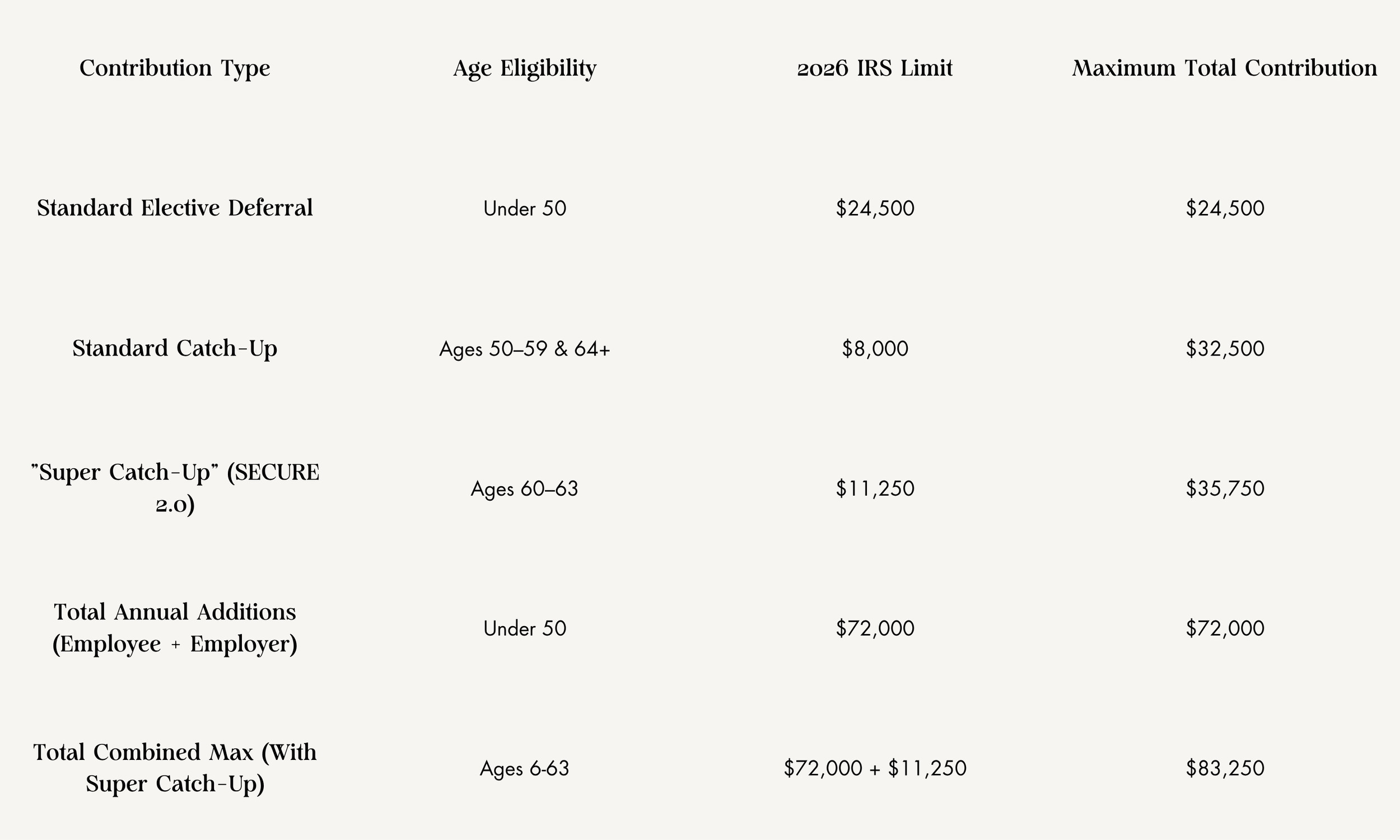
401(k) Limits for 2026: A Quick Overview
Successful wealth management is rarely about reacting to what happened yesterday; it is about anticipating future rule changes and positioning your assets accordingly.
The framework governing workplace retirement accounts is transitioning. Driven by provisions within the SECURE 2.0 Act and annual cost-of-living adjustments, the 401(k) landscape for 2026 includes key structural updates. For high-net-worth individuals, business owners, and those nearing retirement, understanding these numbers is essential for maintaining tax efficiency and preserving cash flow.
Here is a clear look at the limits for 2026 to help you fine-tune your savings and tax strategy.
Baseline Elective Deferral Limits
The IRS adjusts contribution limits annually using cost-of-living index calculations.
For 2026, the standard elective deferral limit, the amount an employee can contribute directly from their compensation, is $24,500.
Standard Deferral Cap: $24,500 for W-2 employee contributions.
Application: Applies across all employee elective deferrals combined, whether directed into traditional pre-tax or Roth 401(k) buckets.
For higher-earning professionals, maximizing this baseline limit shelters a larger portion of earned income from immediate taxation, lowering current-year Adjusted Gross Income (AGI).
Catch-Up Contributions & The "Super Catch-Up" (Ages 60–63)
The most noticeable update under SECURE 2.0 is the creation of a tiered catch-up contribution framework based on your age.
While individuals aged 50 and older retain access to standard catch-up contributions, a higher tier applies specifically to individuals in their early 60s.
Standard Catch-Up (Ages 50–59 and 64+): $8,000.
Super Catch-Up (Ages 60–63): $11,250.
If you turn 60, 61, 62, or 63 during the calendar year, this expanded threshold allows you to defer up to $35,750 in total employee contributions ($24,500 base + $11,250 super catch-up). For individuals in this four-year window, it provides an efficient way to increase tax-advantaged savings immediately before transitioning out of the workforce.
Mandatory Roth Catch-Up Rules for High Earners
A major compliance rule under SECURE 2.0 alters how high earners execute catch-up contributions.
If your prior-year FICA (Social Security) wages from your employer exceeded $150,000, all age-based catch-up contributions must be made on a Roth (after-tax) basis.
Key impacts include:
Loss of Upfront Deduction: Catch-up dollars will no longer reduce your current-year taxable income.
Tax-Free Growth: Contributed funds grow tax-free, and qualified distributions in retirement come out completely tax-free.
Cash Flow Adjustments: Because taxes are paid in the year of contribution, high earners may need to adjust payroll withholding or estimated tax payments to avoid underpayment surprises.
Total Annual Additions (Section 415c)
While employees typically focus on their own elective deferral cap, business owners and corporate executives must monitor the "Total Annual Additions" limit. This cap applies to the sum of employee deferrals, employer matching, and profit-sharing contributions.
Total Contribution Cap: $72,000 per individual (or up to $80,000 with standard catch-up, and $83,250 with super catch-up).
For business owners utilizing Solo 401(k)s or profit-sharing structures, this overall limit defines the total tax-deductible capacity available to reduce corporate or individual taxable income.
Strategic Steps to Take for 2026
Audit Your Birth Year: Identify the exact tax years you qualify for the $11,250 Super Catch-Up limit (ages 60 through 63) to ensure payroll deferrals are set correctly.
Review Prior-Year Box 3 W-2 Wages: Check if your prior-year wages crossed the $150,000 threshold to determine whether your catch-up contributions must be designated as Roth.
Rebalance Retirement Cash Flow: If forced Roth catch-ups increase your taxable income, coordinate with your team to review tax withholdings and maintain your targeted take-home pay.
Shaping your strategy ahead of time ensures you maximize every dollar allowed under current rules without creating cash flow friction.
If you are within ten years of retirement and want to evaluate how these updated contribution limits fit into your overall tax and withdrawal strategy, we are here to help. Read more about our approach to 401(k) planning, or reach out to start a conversation with our team today.
Frequently Asked Questions
-
The standard 401(k) employee elective deferral limit for 2026 is $24,500. This limit applies to total employee contributions across both traditional pre-tax and Roth 401(k) accounts during the tax year.
-
Under the SECURE 2.0 Act, employees aged 60, 61, 62, and 63 qualify for a higher catch-up contribution limit of $11,250 in 2026. Combined with the baseline deferral limit of $24,500, individuals in this age bracket can contribute up to $35,750 in total employee contributions.
-
Beginning in 2026, employees whose prior-year FICA wages exceeded $150,000 from their current employer are required to make all age-based catch-up contributions on a Roth (after-tax) basis. These contributions no longer reduce current-year taxable income, but distributions in retirement will be tax-free.
-
For 2026, the maximum total annual addition limit under Section 415(c), which includes employee deferrals, employer matching, and employer profit-sharing, is $72,000. For employees age 50 and older utilizing catch-up provisions, the total limit increases to $80,000 (or $83,250 for those qualifying for the Super Catch-Up).
Disclosure: All advisory services are offered through Savvy Advisors, Inc. (“Savvy Advisors”), an investment advisor registered with the Securities and Exchange Commission (“SEC”). Savvy Wealth Inc. (“Savvy Wealth”) is a technology company and the parent company of Savvy Advisors. Savvy Wealth and Savvy Advisors are often collectively referred to as “Savvy”. The Retirement Studio is used for marketing purposes only. The Retirement Studio is not a separately registered investment advisor.
